Flyt Creative Launches New CRE FO Website Built To Attract High-Value Real Estate Owner-Operators (And Filter Out Everyone Else)

Flyt Creative’s development team announced the launch of a new website for The CRE FO (Commercial Real Estate Financial Officer), a fractional CFO model designed specifically for real estate owner-operators managing multi-entity portfolios and complex capital structures. Built To Pre-Qualify, Not To Persuade Everyone The site is intentionally direct and designed to filter. It positions CRE FO as senior CFO leadership without a full-time hire, using clear language around decision clarity, capital risk, and accountability—without sliding into generic “fractional CFO” messaging. Clear Conversion Path: Start With The Diagnostic The website centers the CRE FO Diagnostic as the entry point, framing it as the baseline-setting assessment that surfaces risk, pressure-tests assumptions, and produces a decision roadmap before any execution begins. From there, it maps the engagement path into a focused 90-day sprint and, when appropriate, an ongoing embedded partnership. Proof Without Fluff: Outcomes Over Deliverables Instead of leading with a service menu, the site emphasizes outcome shifts—like clearer cash visibility, improved decision velocity, and stronger lender/investor narratives—positioning CRE FO as a strategic operator-level function, not a task-based vendor. Statement From Flyt Creative “This website was built to do one job: attract sophisticated operators who value clear thinking and measurable outcomes, and filter out everyone looking for a ‘fractional CFO’ catch-all. Clarity converts—fluff doesn’t.” — Whitney Messervy, Owner, Flyt Creative About The CRE FOThe CRE FO provides senior financial leadership for real estate owner-operators navigating multi-entity complexity and capital structure risk, anchored by a fixed-fee Diagnostic and customized ongoing support. About Flyt CreativeFlyt Creative designs and develops conversion-focused websites and digital platforms built for clarity, positioning, and qualified lead flow. Press ContactWhitney MesservyFlyt Creative843-504-0396whitney@flytcreative.com
Flyt Creative Launches New Steady & Sage Website Built For Calm, Consistent Clients (Not Chaos)
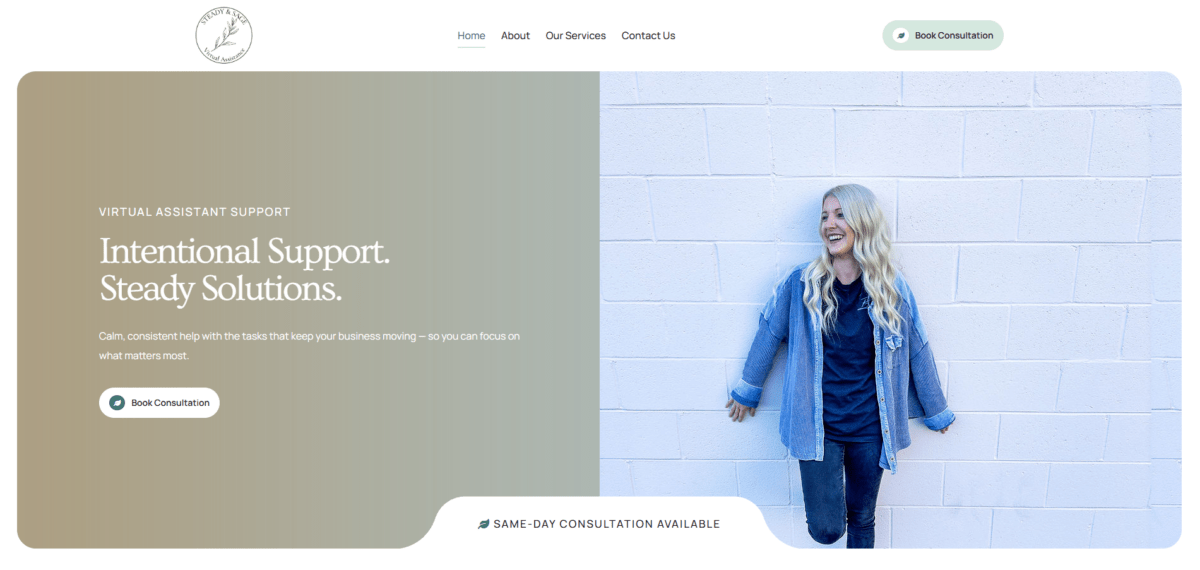
Flyt Creative’s development team announced the launch of the new website for Steady & Sage Virtual Assistance, a service built for entrepreneurs, creatives, and small business owners who want consistent operational support—without the frantic “VA marketplace” vibe. Built To Filter For The Right Kind Of Client Steady & Sage is not positioned as “we’ll do anything.” The website intentionally filters for clients who value structure, consistency, and communication—people who want operational support they can rely on. Packaged Support With Clear Pricing The site makes buying simple with clearly presented monthly packages: One Clean Conversion Path: Consult → Clarity → Support The site prioritizes one primary action—booking a consultation—supported by a streamlined intake flow that keeps discovery calls focused and discourages low-intent inquiries. Statement From Flyt Creative “This site was designed to feel like the service: calm, capable, and clear. The goal is to help the right clients self-select fast—then make the next step effortless.” — Whitney Messervy, Owner, Flyt Creative About Steady & Sage Virtual AssistanceSteady & Sage provides calm, intentional VA support through monthly packages and add-ons designed to reduce overwhelm and keep work moving. About Flyt CreativeFlyt Creative designs and develops conversion-focused websites built for clear positioning, qualified lead flow, and real business outcomes. Press ContactWhitney MesservyFlyt Creative843-504-0396whitney@flytcreative.com
The Real Estate Content Stack: Blogs, Reels, and Emails That Actually Generate Listings and Leads

If you post “Just Sold!” one more time, your followers might stage an intervention. Because let’s be honest: the average real estate agent’s feed looks like a hard-sell carousel with no soul. The secret? You don’t need more content; you need a better stack—a repeatable content ecosystem that actually converts eyeballs into listings, leads, and trust. Let’s unpack The Real Estate Content Stack™: a system built around blogs, reels, and emails that work together so you stop posting and hoping and start feeding a pipeline that sustains itself. Why most agent content flops Most agents create content the same way they host an open house—show up, put in effort, then move on. The issue isn’t the effort; it’s the lack of connection between posts. You can’t rely on random likes to generate predictable leads. Today’s attention spans demand stories, repetition, and funnels. A strong content stack keeps your marketing alive long after posting. The three layers of your content stack Each layer feeds the next. Your blog gives you reel ideas. Your reel creates teasers for your email newsletter. Your email links back to your blog. That’s how agents like you start seeing engagement compound instead of evaporate. How to create synergy between layers Let’s take an example:You write a blog titled “Why Listing Photos Can Make or Break a Sale.” From that one blog, you can now: You’ve now squeezed a week’s worth of content out of one idea. That’s what an efficient content stack does—it reduces overwhelm and amplifies impact. Optimize each layer for search and AI Each content type plays a role in visibility: Consistency across formats helps AI and humans link all your content together into a cohesive, credible brand narrative. Why local storytelling still wins Every agent claims “local expertise.” Few prove it. Your content should prove it within seconds. Examples: AI-powered answer engines love data density. Humans love local flavor. AEO-friendly storytelling gives them both. Balancing helpfulness and marketing The tone that works? Local guide meets witty sidekick.Avoid over-selling every post. Instead, shift your CTA from “Hire me!” to “Here’s something I learned that might help you.” People trust generosity more than urgency. When your content consistently helps before it sells, your inbox fills up faster. Measuring success differently Don’t evaluate by likes alone. Measure by: Those are the numbers that show your content isn’t just performing—it’s persuading. The evergreen advantage Your content stack compounds because blogs and reels don’t expire. A well-optimized article from this year can keep generating leads next year, especially when paired with seasonal refreshes and timely video updates. Repurpose, refresh, recycle—it’s not laziness; it’s leverage. Key Takeaways With a smart stack, real estate marketing becomes less about hustling for your next client and more about building a system that keeps clients coming to you.
Why Generic Content Fails Law Firms: A Guide to Building Trust With Every Page

Let’s be honest—most law firm websites sound exactly the same.“Experienced. Professional. Dedicated to results.” We’ve all read it a hundred times, and that’s the problem. It’s not that the information is wrong; it’s that it’s indistinguishable. When everyone sounds “professional,” no one stands out. And for a potential client? That’s confusing. Because legal services aren’t impulse buys. People hire lawyers based on trust, not buzzwords. In a crowded digital world, generic content doesn’t just fail to attract—it actively drives readers away. So how do you write in a way that builds trust from the first click? Understanding what searchers actually want When someone lands on your site, they’re not there to admire your resume. They’re there to fix a real, stressful life problem: a car accident, a divorce, an estate dispute, a business issue. They’re not looking for impressive. They’re looking for helpful. The subtle difference between those two tones changes everything about your website’s performance. Instead of paragraphs stuffed with firm history, your content should start by answering the actual questions running through a visitor’s mind, like: If your website answers those implicitly, you’ve already outperformed half your competitors. How AEO changes law firm marketing AI answer engines don’t just index keywords like “personal injury attorney Greenville.” They read your content and assess whether it actually answers user intent. That means the text on your practice area pages should sound like it’s responding to real human queries—because that’s literally what AI search crawlers look for. Try rewriting your FAQ sections into conversational, self-contained answers: Instead of:“Flyt Law Firm handles a wide range of personal injury claims.” Try:“If you were injured in a Greenville car accident and aren’t sure who’s at fault or how to file insurance claims, our team helps you collect evidence, handle negotiations, and recover compensation—without confusing legal jargon.” See the difference? That’s AEO at work. It feeds the AI engines clear answers and feeds humans instant relief. Trust-building through tone The biggest misconception among law firms is that sounding “serious” means stripping out humanity. In reality, people associate clarity, empathy, and plain English with credibility. Your content should balance three tones: A great rule of thumb: write like you’re talking to a smart friend, not cross-examining them. Local relevance wins cases—and clicks If you practice in Greenville or anywhere in South Carolina, every page should sound like it. AI elevates region-specific detail. Include: When answer engines summarize your page, they’ll cite it as the localized authority. And when people see that local detail, your perceived legitimacy skyrockets. The FAQ goldmine Don’t underestimate FAQ sections. They naturally hit both SEO and AEO signals.Think of FAQs as mini blog posts inside your main pages. Each can target long-tail search phrases like: The more directly you answer, the more likely AI assistants are to quote your firm by name. What generic content gets wrong Most legal content fails because it assumes authority is earned through formality. It’s not. Authority is earned through helpfulness and clarity. Common sins of legal web content: Every line that could appear on your competitor’s site dilutes your credibility. Every line that only you could write builds it. Writing for both clients and AI Let’s stack the deck in your favor.Each page should accomplish three goals simultaneously: When done right, your pages do double duty: they reassure potential clients and rise through AI search summaries naturally. The visual side of trust Copy alone isn’t enough. The content experience—the page layout, visuals, and flow—also shapes trust.Support every page with: Every visual cue reinforces the feeling: “This firm actually gets it.” Key Takeaways By speaking human first and lawyer second, your firm doesn’t just attract clicks—it builds credibility in a world dominated by both search engines and answer engines.
How Small Businesses Can Use AI (Without Sounding Like Everyone Else Online)

Everyone says “use AI for your business.” Few say how to do it without sounding like a copy-and-paste robot. If you’re a small business owner, AI can be your ultimate sidekick—or your biggest content liability. The difference? Voice. Let’s unpack how to use AI tools to scale your marketing, creativity, and systems—without losing that one thing the internet desperately needs more of: you. The great AI sameness problem AI made writing faster. But it also made the internet eerily repetitive. There are now millions of near-identical LinkedIn posts starting with “3 ways to use ChatGPT for productivity.” What went wrong? People let AI become the driver instead of the wingman. For small businesses, your advantage isn’t massive ad budgets or 50-person teams. It’s personality, the unmatched ability to sound like an actual human with a unique story. Your customers don’t buy from the most automated brand. They buy from the one that feels real. The smart way to pair human + AI Think of AI as your creative intern—smart, fast, but not fully trained in your brand’s vibe yet. You wouldn’t let an intern publish unedited copy, right? Same goes for generative text. Use AI to: Then, use your human intuition to: Together, you get scalability and authenticity. The practical toolkit for small business AI use If you’re just getting started, stick with accessible, high-ROI tools: But here’s the trick—each tool should have a personality filter: your voice. Building your AI voice guide Create a simple “Brand Voice Sheet” in your AI prompts. Include: Every time you ask AI to write something, “train” it by repeating those cues. Over time, the output will sound increasingly like your true brand voice—not generic mush. Storytelling > templates AI loves structure, but humans love stories. Replace generic LinkedIn tips with real client anecdotes or behind-the-scenes lessons. Example: Instead of “5 Tips for Marketing Your Bakery,” write “How Our Bakery Went Viral After a Doughnut Disaster.” You’ll still teach something—just through relatability. Finding your AI-human balance The magic ratio? About 70% AI, 30% you. Let AI do the heavy lifting—drafts, outlines, and even research—but make sure the sparkle comes from you. Inject humor, use voicey transitions (think “anyway, here’s the fun part…”), and avoid the sterile “corporate wisdom” tone that users scroll right past. Measuring whether AI is helping Set time-based goals instead of vibe-based ones. If you adopt AI content support, measure these markers monthly: If fatigue decreases and authenticity stays intact, congrats—you’re doing it right. Key Takeaways By using AI thoughtfully, small businesses can sound big without losing their charm. Automation doesn’t kill creativity—it amplifies it when directed by the right human. And in a world where sameness is easy, the most rebellious thing you can do is stay unmistakably yourself.
From SEO to AEO: How Brands Can Actually Get Found in an AI-First Search World
If your marketing strategy still treats Google like the center of the universe, pull up a chair. The internet just shifted—again—and the old search game isn’t just evolving, it’s completely rewriting the rulebook. We’re officially living in an AI-first search world, where answer engines—like ChatGPT, Perplexity, and Google’s AI Overviews—decide which content to surface, summarize, and trust. Instead of showing ten links, they give one answer. And here’s the kicker: they’re pulling from your site. Or, well… your competitor’s site, if you’re not paying attention. So let’s talk about what it actually means to move from SEO (Search Engine Optimization) to AEO (Answer Engine Optimization)—and how to make sure your brand doesn’t become invisible in an era where people don’t even click search results anymore. The end of “ranking” as we knew it Once upon a time, SEO was about one thing: climbing to page one. You identified keywords, built backlinks, stuffed your paragraphs just right, and hoped Google’s crawlers noticed. But answer engines don’t index the same way. They interpret. They use large language models (LLMs) to read your content like a human would—analyzing intent, tone, and clarity to figure out whether you’re actually answering a question. In AI search, it’s not enough to be keyword-rich. You need to be knowledge-rich. When ChatGPT or Perplexity generates an answer, it’s performing real-time summarization from multiple trusted sources. The key is to make your brand that trusted source. What makes content “AI-friendly”? AI engines don’t scan entire pages—they dissect pieces. Think of them as chefs gathering ingredients from everywhere to make one perfect recipe for the answer. Your job? Be the high-quality ingredient they pick every time. To do that, your content needs to hit these pillars: Beyond keywords: the new language of authority In an AI-first world, authority isn’t about quantity—it’s about context. Answer engines look for breadth of knowledge, consistency, and topical depth. That means your content strategy should intentionally build clusters of expertise. For example, instead of one blog about AI trends, build a mini-library that dives into: By connecting these articles internally, you teach both AI and readers that you’re an expert worth quoting. Building “AEO-ready” pages Here’s a practical checklist for every page Flyt Creative builds moving forward: What most brands are still doing wrong Most businesses still create for humans only, or machines only—but never both. The truth is you have to write “dually”—with AI as your first auditor and humans as your true audience. Common AEO pitfalls to avoid: When you write like a helpful expert instead of a keyword bot, AI detects confidence and clarity. The brand opportunity of AEO This shift isn’t a threat—it’s the best moment ever to build authority. Few brands are optimizing for answer engines yet, which means you’re not late. You’re early—especially if you start designing content that sounds both intentional and intelligent. AEO-focused content gets referenced more, linked more, and quoted more by AI-driven summaries. And when these summaries dominate the top of search results, that’s free marketing power you didn’t have to pay for. Key Takeaways If your content strategy doesn’t feed answer engines, you’re already half-invisible. But if you flip the script—designing posts built to teach instead of rank—the algorithm won’t just find you. It’ll feature you.
Step-by-step guide to optimizing for AI Engine Optimization AEO

AI Engine Optimization (AEO) is about making your content the “obvious answer” that AI systems choose, not just a blue link that search engines list. This step-by-step guide is written for Flyt Creative and your clients so you can build AEO into your SEO and content process from day one. Key takeaways Step 1: Understand what AEO actually is AEO (AI / Answer Engine Optimization) is the practice of structuring and optimizing content so AI-powered engines can extract concise, accurate answers and feature them in responses. Instead of only ranking entire pages, these systems pull snippets and synthesize them, deciding which brands to trust and reference. Unlike classic SEO, which focuses on keywords and rankings, AEO focuses on: Step 2: Map real questions and user intent Every strong AEO strategy starts with deeply understanding the questions your audience actually asks. AI engines are built around queries that look like natural language, not just short keywords. Ways to gather questions: Group your findings into clusters (for example: “local SEO questions,” “short-form video questions,” “AEO / GEO questions”) and use these clusters to plan content hubs and FAQs. Step 3: Structure pages for clear, extractable answers AI engines prefer content that is easy to scan, segment, and quote. That means your page structure matters as much as the wording. Foundational formatting practices: Think of each section as a “modular answer block” that can stand on its own in an AI response. Step 4: Write answer-first, people-first copy AEO does not mean writing for robots; it means writing human-friendly answers in a way AI can interpret. The first sentence or two under each heading should directly answer the question in simple, precise language. Best practices: This style supports both traditional SEO and AI engines that score content based on clarity, completeness, and usefulness. Step 5: Implement FAQ sections and Q&A patterns FAQs are one of the most AEO-friendly formats you can use. They mirror the way people query AI tools and give engines clean question–answer pairs to reuse. When building FAQs: FAQ blocks also pair well with structured data, which further boosts answer extraction (see the next step). Step 6: Add structured data and schema markup Schema markup helps AI and search engines understand what different parts of your page represent. For AEO, FAQPage, HowTo, Organization, Product, and Article schema are especially valuable. Core schema moves: Schema does not replace good content, but it makes your content easier for AI engines to trust and reuse. Step 7: Strengthen E‑E‑A‑T (experience, expertise, authority, trust) AI engines increasingly factor in signals related to expertise, authority, and trust when deciding whose content to cite. This is where brand-building and AEO intersect. Ways to show E‑E‑A‑T on-page: For Flyt Creative, showcasing your marketing experience, client results, and thought leadership directly inside content helps AI engines see your pages as safe, credible answers. Step 8: Build topic clusters and internal link hubs AI engines look for patterns and context across your site, not just isolated pages. Topic clusters—groups of content around one theme—signal depth and authority. Practical AEO cluster strategy: This “hub and spoke” structure helps answer engines understand your expertise at the topic level, making your brand more likely to appear in broader AI responses. Step 9: Optimize for conversational queries and long-tail intent AI and answer engines excel at handling natural language questions. That means long-tail, conversational queries become even more important than in classic SEO alone. Tactics to support conversational AEO: This makes your content a better fit for both typed and voice-style queries funneled into AI engines. Step 10: Ensure technical accessibility for AI crawlers If AI-driven systems cannot easily access or parse your content, they will not use it—regardless of quality. While each platform has its own specifics, several technical fundamentals are broadly useful. Technical readiness checklist: The goal is to avoid unnecessary friction between your content and the systems trying to read it. Step 11: Monitor AI visibility and iterate AEO is not “set it and forget it.” The landscape—and models—change, so ongoing monitoring and refinement are crucial. Ways to monitor and refine: Treat AEO like SEO: an ongoing, iterative process tied to real user questions and performance data. FAQ: AEO basics Q: What is AI Engine Optimization (AEO) in simple terms?A: AEO is the practice of structuring and writing content so AI-powered answer engines can easily find, understand, and reuse your content as the answer to user questions, boosting brand visibility in AI-generated responses. Q: How is AEO different from traditional SEO?A: SEO focuses on ranking full pages in search results using keywords, links, and technical signals, while AEO emphasizes clear, structured answers at the snippet level so AI systems can quote you directly in their responses. Q: Does AEO replace SEO?A: No—AEO builds on SEO rather than replacing it. Strong technical SEO, content quality, and authority are still prerequisites, with AEO adding answer-focused structure and formatting on top. FAQ: Getting started with AEO for Flyt Creative and clients Q: What’s the first practical step for a brand just starting with AEO?A: Start by turning your most important service or topic pages into answer-first resources: add clear definitions, structured headings, and FAQ sections that mirror your audience’s real questions. Q: Which content types should we prioritize for AEO?A: Prioritize educational blog posts, service pages, comparison guides, and FAQs that answer high-value questions—these are the formats AI engines most often draw from for responses. Q: How long does it take to see impact from AEO work?A: Timing varies, but as AI systems refresh and retrain on web content, consistently structured, answer-centric content tends to gain visibility over weeks to months, similar to SEO timelines.
Top short form video strategies for brand growth in 2026
Short-form video will be one of the most powerful growth levers for brands in 2026 across TikTok, Instagram Reels, YouTube Shorts, and emerging AI-driven feeds. This blog is written for Flyt Creative with SEO, AI, and AI EO in mind so it can perform well across search, social, and AI answer engines. Key takeaways Why short-form video dominates brand growth in 2026 In 2026, short-form video is the primary way many users discover new brands, learn quickly, and decide who to follow and buy from. Algorithms prioritize engaging, watchable content that keeps users on the platform, and brands that understand this dynamic see compounding returns from consistent posting. Short-form formats are also highly shareable, meaning a single strong concept can travel far beyond a brand’s existing audience. For Flyt Creative and its clients, this means short-form video is not a side project—it is core to a modern content strategy. When planned strategically, these clips support brand awareness, nurture trust, and guide viewers into deeper content, email lists, and offers. Strategy 1: Hook-first, value-dense videos The first 1–3 seconds of a short-form video determine whether a viewer scrolls past or stays. A hook-first approach is essential for brand growth because it signals relevance immediately and keeps users engaged long enough to hear the message. Strong hooks often: Once the hook lands, the rest of the video must deliver value quickly—one promise, one insight, one tip, one transformation per clip. This “one idea per video” rule makes content easier to remember, share, and binge, which feeds platform algorithms and AI systems looking for clear, structured content. Strategy 2: Design for vertical, sound-off, and fast consumption Short-form videos in 2026 must be created for the real viewing environment: vertical screens, mixed sound-on/sound-off usage, and fast scroll behavior. Brands that design with these constraints in mind see higher completion rates and better performance. Key best practices include: This approach not only helps with human viewers but also supports AI and AI EO, since clear text, structure, and visuals make it easier for systems to understand and summarize the content. Strategy 3: Lean into niche-specific content, not generic trends While trending audio and formats still matter, generic “viral” content rarely builds a loyal audience or real growth for brands. The most effective short-form video strategies in 2026 focus on niche-specific content that speaks directly to a defined target. For example, instead of “marketing tips,” Flyt Creative might post: Niche content: This niche-first strategy aligns with AI EO, as bots and assistants prefer specialized, clearly scoped insights when choosing what to surface. Strategy 4: Turn one idea into multiple short-form assets Repurposing is critical for sustainable brand growth with short-form video. Instead of constantly chasing new concepts, the best strategies recycle and remix the same core ideas across formats and platforms. From one long-form piece (a blog, podcast, or YouTube video), a brand can: This system multiplies output without burning out the team and gives AI tools more consistent data to learn what works for your audience. Strategy 5: Storytelling and narrative mini-series Short-form doesn’t mean shallow. In 2026, brands that use narrative and recurring series will see stronger retention and brand affinity than those only posting one-off tips. Viewers follow stories, not just videos. Effective storytelling formats include: These narrative arcs encourage viewers to come back, binge multiple videos, and follow for more, which sends strong signals to platform algorithms and AI ranking systems that your content is worth amplifying. Strategy 6: CTAs that drive real growth, not just views Views and likes are helpful indicators, but brand growth comes from turning that attention into action. Strong calls-to-action (CTAs) in short-form video tell viewers clearly what to do next. Examples of effective CTAs: CTAs should feel natural and value-focused, not pushy. Over time, consistent, clear CTAs help grow email lists, website traffic, and leads—not just vanity metrics. Strategy 7: Use AI tools as your creative co-pilot AI is a force multiplier for short-form video strategy in 2026. Instead of replacing creativity, it speeds up ideation, scripting, editing, and optimization so brands can ship more and learn faster. AI can support by: AI EO comes in when you design scripts and captions using natural language queries and FAQ-style phrasing, so AI-powered assistants and recommendation systems better understand and surface your content. Strategy 8: Optimize titles, captions, and metadata for search and AI EO Short-form video is now deeply integrated with search behavior: users search on TikTok, YouTube, Instagram, and inside AI assistants just like they do on Google. That makes search-optimized titles and captions crucial. Best practices: This dual optimization for search and AI EO helps your videos appear when people ask questions, whether they’re typing in a search bar or speaking into an assistant. Strategy 9: Post consistently, test relentlessly, and double down on winners In 2026, consistency and experimentation matter more than perfection. Platforms and AI systems favor accounts that post regularly and stay in their lane while still testing creative variables. A simple growth framework: Brands that treat short-form video like an ongoing lab outperform those relying on sporadic “big ideas.” FAQ: Short-form video strategy basics Q: How long should short-form videos be for brand growth in 2026?A: Most brands see strong performance in the 15–45 second range, with some success in ultra-short 5–8 second loops and occasional 60–90 second explainers when the hook is strong and the content is highly relevant. Q: How many times per week should a brand post short-form videos?A: A common sweet spot is 3–7 times per week per platform, adjusted based on resources. It is better to post fewer high-quality, on-niche videos consistently than to post daily and burn out with off-brand content. Q: Do we need to be on TikTok, Reels, and YouTube Shorts all at once?A: Not necessarily. Start where your audience already spends the most time, then expand. Many brands find success focusing on one primary platform and repurposing to others once they have a proven content system. Q: Is it still worth
Meet Your New Favorite Employee: The AI Agent (And Why It’s Different Than ChatGPT)

We’ve all been there. You open ChatGPT, ask it to write an email or a caption, and marvel at the magic. It’s cool, it’s fast, and it’s helpful. But let’s be honest—it’s still just a chatbot. You have to prompt it, check it, and paste the result somewhere else. It’s a tool, not a teammate. But while most of the world was busy playing with chatbots, a quiet revolution started happening in the background. It’s called Agentic AI, and by the end of 2025, it’s going to change small business operations forever. At Flyt Creative, we pride ourselves on staying “10 steps ahead” so our clients don’t have to. Today, we want to introduce you to the concept of the AI Agent—and explain why it’s the productivity unlock you’ve been waiting for. The Difference: Thinking vs. Doing To understand AI Agents, you have to understand the limitation of standard Generative AI (like the basic version of ChatGPT). Think of it this way: Generative AI is like a brilliant consultant who gives you great advice but leaves you to do the work. An AI Agent is like a diligent executive assistant who takes the advice and actually does the work for you. What Can an AI Agent Actually Do? This isn’t science fiction anymore. In 2025, 68% of small businesses report using AI regularly, and the smartest ones are moving toward agents. Here is what that looks like in practice: 1. The “Always-On” Customer Service Rep We aren’t talking about those annoying “Press 1 for Service” bots. Modern AI agents can be trained on your specific business data—your PDFs, your website, your past emails.They can sit on your website and handle complex customer queries 24/7. They can check order statuses, book appointments directly into your calendar, and even handle refunds up to a certain dollar amount—all without you waking up. 2. The Ruthless Data Analyst Most small business owners drown in data but starve for insights. You have numbers in QuickBooks, numbers in Google Analytics, and numbers in your POS system.An AI Agent can connect to these systems and monitor them for you. Instead of you digging through spreadsheets, an agent can send you a Slack message Tuesday morning saying: “Heads up: Your ad spend on Facebook is up 20%, but conversions dropped. I recommend pausing Ad Set B.” 3. The Automated Project Manager Imagine an agent that monitors your email inbox for invoices. When one arrives, the agent reads it, extracts the data, enters it into your accounting software, and drafts a payment for your approval.This is “Agentic” workflow. It’s not just writing the email; it’s completing the transaction. Why This Matters for Small Business The biggest lie in business is that you have to “hustle” 24/7 to succeed. The truth is, you just need leverage.Large corporations have armies of staff to handle admin, data, and scheduling. Small businesses have… you. AI Agents are the great equalizer. They give you the leverage of a Fortune 500 company on a small business budget. They don’t get tired, they don’t need health insurance, and they don’t take weekends off. The Human Element (Where We Come In) Now, does this mean robots are taking over? Absolutely not.AI Agents are powerful engines, but they still need a steering wheel. They need strategy. An AI agent can post to your social media, but it can’t capture the heart of your brand story.It can analyze your data, but it can’t decide on your company’s vision.It can answer customer questions, but it can’t build a relationship. That is why Flyt Creative exists. We believe in using technology to amplify humanity, not replace it. We use these advanced tools to automate the boring stuff—the reporting, the scheduling, the basic data entry—so that we (and you) can focus on the creative, strategic work that actually grows your business. The Future is Automated The businesses that win in 2025 won’t be the ones working the hardest. They will be the ones working the smartest.Adopting AI agents isn’t about being “techy.” It’s about valuing your time enough to stop doing work that a machine can do for you. Ready to see how automation can free up your time? Let’s chat. Whether it’s automated review management or a smart funnel that nurtures leads while you sleep, Flyt Creative builds the systems that make your business fly.
Top Digital Marketing Trends to Watch in 2026
Digital marketing in 2026 will be faster, smarter, and more AI-driven than anything marketers have seen before. Small businesses that adapt now will be miles ahead as customer behavior, privacy rules, and search itself evolve. Key takeaways Why 2026 will redefine digital By 2026, AI-powered discovery experiences will rival or replace traditional search for many users, shifting marketing from “rank on page one” to “be the trusted answer anywhere people ask questions.” At the same time, social platforms, AI agents, and smart devices will blur the lines between ads, content, and conversations. For Flyt Creative and its clients, this shift means strategies must be built for search, social, and AI simultaneously, with consistent branding and content that works in articles, chats, feeds, and voice responses. Trend 1: AI-driven personalization everywhere AI in marketing will no longer be a “nice to have” add-on; it will be the backbone of targeting, creative, and optimization. From email to paid ads to on-site experiences, AI will continually analyze behavior and tailor what each user sees in real time. Small businesses can use AI tools to: This level of personalization boosts relevance, conversion rates, and retention while keeping human marketers focused on strategy and storytelling. Trend 2: Short-form video dominance Short-form video is set to account for the majority of consumer engagement across TikTok, Reels, YouTube Shorts, and whatever new AI-powered formats emerge by 2026. Audiences increasingly prefer bite-sized, vertical content that entertains, teaches, or inspires in under 60 seconds. Brands that win will: AI tools will help script, edit, caption, and repurpose these clips at scale, making video accessible even to small local businesses. Trend 3: The future of SEO = AEO, GEO, and “search everywhere” Traditional SEO is evolving into “Search Everywhere Optimization,” where visibility depends on showing up in AI answers, social search, and zero-click formats as much as in classic SERPs. Marketers will optimize for AEO (Answer Engine Optimization) and GEO (Generative Engine Optimization) so brands appear inside AI-generated responses and overviews. Key moves for the future of SEO: For Flyt Creative’s clients, this means blogs, landing pages, and even social posts should be written to answer niche questions deeply, not just target broad keywords. Trend 4: Local SEO automation and “always-on” presence Local SEO will become more automated as platforms and tools handle listings, reviews, and NAP consistency across the web. Businesses that plug into these systems will maintain accurate information, respond quickly to reviews, and publish updates without manual busywork. Automation will help small businesses: This “always-on” presence supports both traditional local search and AI assistants that pull local recommendations directly into conversational answers. Trend 5: Data privacy, consent, and first-party data Tighter privacy laws and cookie deprecation will force a shift from intrusive tracking to consent-based, relationship-driven marketing. Brands will rely more on first-party data collected through newsletters, loyalty programs, and owned communities. Smart marketers will: This puts pressure on creative quality and user experience but rewards brands that build genuine trust and transparency. Trend 6: Human-first content in an AI-saturated world As AI-generated content explodes, audiences will crave originality, taste, and authentic human perspective. “Unshittification” of marketing means brands that prioritize depth, creativity, and voice will stand out from generic AI noise. What wins in 2026: AI will still play a key role, but as a co-pilot for ideation, research, and editing while humans guide strategy and storytelling. FAQ: Digital marketing trends 2026 Q: Which digital marketing trend will have the biggest impact for small businesses in 2026?A: AI-driven personalization combined with short-form video will likely have the largest impact because it directly affects how customers discover brands, engage with content, and make purchase decisions. Q: Is SEO still worth investing in if AI is taking over search?A: Yes—SEO is evolving, not disappearing. The focus is shifting to AEO and GEO, where high-quality, authoritative content feeds AI systems and drives visibility in conversational answers. Q: How can a small local business keep up with these trends without a big team?A: Start with a simple stack: one AI writing tool, one scheduling platform, and a local SEO management tool, then focus on consistent short-form video and one or two flagship content formats. Practical steps for small businesses now Small businesses do not need enterprise budgets to prepare for 2026; they need clarity and consistency. A focused, layered approach will beat scattered experiments every time. Actions to implement in the next 3–6 months: With the right strategy, 2026’s digital marketing trends are less of a threat and more of an opportunity for agile, creative businesses to leap ahead. FAQ: AI in marketing and AI EO Q: What is AI EO and how is it different from traditional SEO?A: AI EO focuses on optimizing content for AI and answer engines—ensuring your brand is referenced in AI-generated responses across chatbots, voice assistants, and AI search experiences, not just listed in search results. Q: How can businesses use AI ethically in marketing?A: Be transparent when content is AI-assisted, protect user data, and use AI to enhance—not replace—human creativity and customer care.